
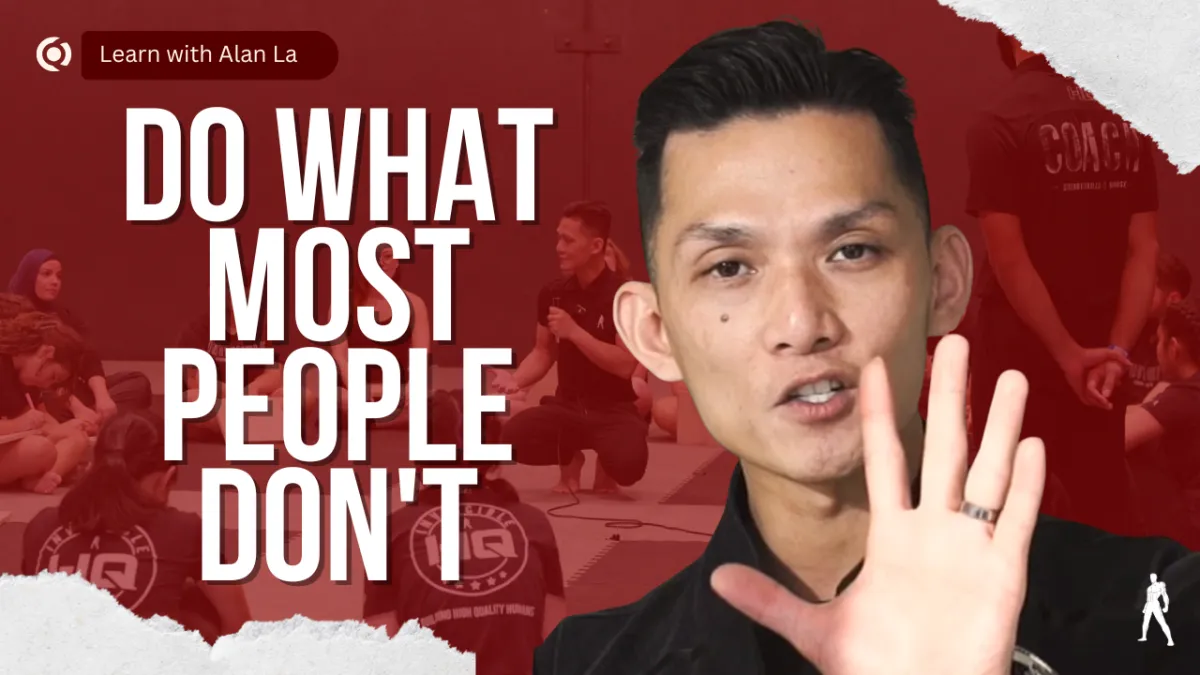
5 Keys To Mastering Your Life: Lessons From Alan La's Life Skills Masterclass
At 12 years old, I didn't know what I wanted.
My parents drove me across Sydney to a personal development program they could barely afford. My mum said, "Just make sure you learn as much as you can."
I sat in that room and wrote down three goals. A backflip before graduation. 95% in my HSC. $50 an hour by 20.
My mentor looked at them and said, "Think bigger."
I thought he was crazy.
I landed the backflip at graduation. I scored 98 in my HSC. And by 20, I was earning $63 an hour.
That program didn't give me talent. It gave me a framework.
I'm Alan La, founder of Invincible HQ in Wetherill Park and Invincible Worldwide. Over the past 20 years, I've trained more than 12,000 students across Western Sydney and around the world in martial arts, personal development, and life skills. I recently ran a Life Skills Masterclass where I shared the five strategies that have shaped everything I've built, from a car park rooftop to a multi-award-winning academy.
Key #1: How To Set Goals That Actually Work
Most people write goals wrong.
They write "I will achieve 95%." Or "I want to become a singer." The problem with "I will" is that your brain keeps chasing. You're always in pursuit. Never arriving.
The shift: write your goals in past tense.
"I have achieved 98 in my HSC."
"I am a professional singer."
"I have published my first book."
This isn't wishful thinking. It's subconscious reprogramming. When your brain reads "I have," it starts organising your behaviour around a reality, not a fantasy.
Tony Robbins puts it simply: "Setting goals is the first step in turning the invisible into the visible."
A 13-year-old girl came to one of my talks. She wanted to sing, but she'd spent her life being compared to her sister. She applied this one strategy. A few years later, I was sitting on my couch and saw her on national television, performing in front of the whole country.
One thing. Applied consistently.
Key #2: How To Find 30 Hours a Week You Didn't Know You Had
Everyone says they don't have time.
Let me break it down.
168 hours in a week
56 hours sleeping (8 hours x 7 days)
40 hours working or studying
42 hours eating, commuting, family time, scrolling, downtime
That leaves 30 hours.
Most people let those hours disappear into screens and autopilot. The difference between mediocre and extraordinary is what you do with those 30 hours.
Invest them across five areas:
Physical -- train, move, skip rope for 30 seconds before breakfast (research shows 3 minutes of skipping equals 30 minutes of jogging)
Mindset -- read, listen to podcasts, watch something that stretches your thinking
Career or business -- work on the thing that moves your professional life forward
Relationships -- invest in the people who matter
Finances -- learn about money, build wealth intentionally
To master your life, you master your years. To master your years, you master your months. It all comes down to mastering your day.
A study published in the European Journal of Social Psychology found that habit formation takes an average of 66 days. The 30-hour framework gives you the daily structure to get there.
Key #3: The 50/50 Rule: Why Staying Centred Changes Everything
The yin-yang isn't just a symbol. It's a life operating system.
Life moves in cycles. Day follows night. Winter follows autumn. Good seasons follow hard ones.
The problem: most people ride the wave.
When life is bad, they spiral. "Everything is terrible. I can't do anything right."
When life is good, they coast. "Nothing can go wrong. I'm untouchable."
In martial arts and Zen philosophy, the goal is to stay centred regardless of the season.
When it rains, know the sun will come out.
When the sun is shining, know clouds will return.
Bruce Lee was once at a restaurant when a rude waiter served him. His friend said, "Why don't you beat him up? You're Bruce Lee." Bruce Lee said, "I walked in here in a good mood. Why should I allow him to change that?"
The application: the second you feel anger, sadness, or frustration take control, you are losing the game. The second you blame someone else, you hand them your power.
Stay centred. Take back control. That is the real training.
Key #4: What Kung Fu Actually Means (And Why It Matters)
Most people think kung fu means martial arts.
It doesn't.
Kung fu means perfection through hard work. Refining yourself. Doing things with your whole heart.
Calligraphy is kung fu. Tea ceremony is kung fu. Breathing with intention is kung fu.
Michael Jordan ran 50 warm-up laps like each one was the NBA finals. While teammates jogged, he sprinted. He put excellence into something most people treat as throwaway.
That's kung fu.
When you do small things with care, with quality, with your whole heart, the world opens up. Not because you earned a reward. Because you became the kind of person who does everything at that standard.
"The key to immortality is first living a life worth remembering." -- Bruce Lee
The question isn't whether you're talented enough.
It's whether you're willing to put your name on everything you do and mean it.
These keys aren't theory.
They're the exact strategies I've used since I was 12 years old. From writing goals on a card in a room full of strangers, to building Invincible HQ from a car park in Western Sydney, to retiring my parents.
None of it required special talent. All of it required consistency, clarity, and the willingness to do what most people won't.
The hero isn't someone born different. There's a hero in all of us. The question is whether you'll let that fire burn.
If you're in Western Sydney and you want to experience what training for life actually feels like, book a trial at Invincible HQ in Wetherill Park.
Author Bio
Alan La is the founder of Invincible HQ in Wetherill Park, a multi-award-winning holistic martial arts academy dedicated to Building High Quality Humans. A Martial Arts Hall of Fame inductee and number one best-selling author, Alan has spent over 20 years training more than 12,000 students around the world, including South-Western Sydney. He helps adults and kids unlock real physical capability, confidence, and mental strength.
FAQ Section
Q: Can teenagers benefit from a life skills masterclass?
A: Absolutely. Teenagers often have ambition but lack the framework to channel it. A structured masterclass gives them tools like goal-setting in past tense, time management, and emotional regulation that schools rarely teach. These skills transfer directly to academic performance, confidence, and career readiness.
Q: How many spare hours do I really have in a week?
A: After accounting for sleep (56 hours), work or school (40 hours), and daily necessities like eating, commuting, and downtime (42 hours), the average person has approximately 30 hours per week available. The key is investing those hours intentionally across physical, mindset, career, relationship, and financial growth.
Q: What is the difference between an achiever and a hero?
A: An achiever sets goals and accomplishes them, but often feels empty at the finish line because their identity is tied to outcomes. A hero performs at a high level while staying connected to a bigger purpose. They make an impact beyond themselves. The hero knows they are enough and climbs the mountain while appreciating the view.
Q: Is Invincible HQ just for martial arts?
A: Invincible HQ teaches martial arts as a vehicle for total personal development. The training includes physical capability, mindset coaching, goal-setting frameworks, and life skills. It is designed for adults and kids who want more than fitness; they want character, resilience, and confidence that transfers to every area of life.
Q: What age group is the Life Skills Masterclass for?
A: The masterclass content applies to teenagers, young adults, and adults. Alan La originally learned these principles at age 12 and has taught them to high school students through his Achieve Anything Program as well as to corporate teams. The five keys are universal and age-adaptable.
Q: What are the 5 keys to mastering your life?
A: The five keys are: (1) get clear on what you want and write goals in past tense, (2) master your day by using 30 spare weekly hours intentionally, (3) stay centred through life's ups and downs using the 50/50 rule, (4) practise daily gratitude, and (5) put excellence to your name, which comes from the concept of kung fu meaning perfection through hard work.
Q: What does writing goals in past tense do?
A: Writing goals in past tense ("I have achieved" instead of "I will achieve") reprograms your subconscious mind. Your brain organises behaviour around what it believes is already real. "I will" keeps you chasing. "I have" tells your mind to start living as if the goal has already been accomplished.
Q: What is the 50/50 rule?
A: The 50/50 rule comes from the yin-yang principle. Life moves in cycles of good and bad seasons. Instead of riding emotional highs and crashing in lows, you stay centred. When life is hard, trust it will improve. When life is great, stay grounded. This is a core principle in martial arts and Zen philosophy.
Q: What does kung fu actually mean?
A: Kung fu does not mean martial arts. It translates to perfection through hard work, or doing things with your whole heart. Calligraphy, tea ceremony, and even breathing can be kung fu. The concept teaches that mastery comes from bringing excellence to everything you do, not just fighting.
Q: Who is Alan La?
A: Alan La is the founder of Invincible HQ in Wetherill Park, Western Sydney, and Invincible Worldwide. He is a Martial Arts Hall of Fame inductee, number one bestselling author, and motivational speaker who has trained over 12,000 students worldwide. He teaches life skills through martial arts philosophy.